
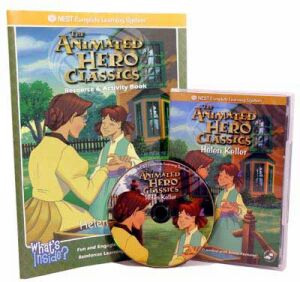
La Animadora Historia De Helen Keller (Helen Keller) Video Interactivo en DVD Contieniendo Un Recurso Downloadable Libro
Teach Love, Kindness, Discipline and other positive character traits through the Nest Learning DVD on the life of Helen Keller. A childhood fever leaves the very bright Helen Keller deaf and blind, cutting her off from human communication. This turns her into an angry, untamed child who often explodes into fits of savage fury. It falls on the spirited shoulders of 21-year-old Anne Sullivan to break into Helen’s dark and silent world and end her awful isolation. Excellent for developing homeschool curriculum and a great teaching resource for the month of June. (Helen Keller’s birthday is June 27, and “Helen Keller Deafblind Awareness Week” is the fourth week in June). Each Interactive Helen Keller DVD features:All features offerred in English and SpanishEnglish and Spanish movie and subtitles and audio dialogHave fun learning history and character with 3-Level Interactive Quiz Bonus Offer - Each Helen Keller DVD includes a Free Instant Download of our 48 Page Activity and Coloring bookThis dramatic and deeply moving story captures all the humor, pain and ultimate triumph of Anne’s quest to help Helen overcome incredible obstacles and find her freedom.Main Characters:Helen Keller, Arthur Keller, Kate Keller, Doctor, Anne Sullivan, Laura Bridgman, and Michael AnagnosOverall Theme:Helen Keller is young and unable to learn without assistance due to her blindness and loss of hearing. Her teacher, Anne Sullivan, is patient and is able to bring structure and order to Helen’s life, as well as an understanding and appreciation for learning and sharing that love of learning with others. Helen Keller graduated college and lectured in countries other than her native United States. Summary: Helen Keller (June 27, 1880-June 1, 1968) was an American author, activist, and lecturer. Born in Alabama to Captain Arthur H. Keller, a former officer of the Confederate Army and Kate Adams Keller, second cousin of Robert E. Lee, Helen came down with an illness that left her deaf and blind at the age of only nineteen months. When Helen Keller was a young child, she contracted a high fever that left her sightless and unable to hear. Being the parents of a non-seeing and non-hearing child was a hardship on two loving parents who did all they could but seemed to do it in the wrong way. Alexander Graham Bell advised Helen’s parents to contact the Perkins Institute for the Blind, which assigned 20-year-old Anne Sullivan to become Helen’s teacher. Out of desperation, they hired a young educator, Anne Sullivan, to teach and train the young Helen. Much to the parent’s dismay, Sullivan was a strict and firm disciplinarian with the young, spoiled Keller girl. Sullivan and Helen Keller moved into a house not far down the lane from the main Keller house. There they began to develop a trust and relationship of love and respect for each other. This soon turned into an atmosphere that was ripe for learning without the interference of the Keller parents.Forced to isolate Helen from her family in order to re-teach discipline and manners, Anne Sullivan helped Helen overcome incredible obstacles to find her freedom. Helen's big breakthrough in communication came one day when she realized that the motions her teacher was making on her palm (sign language) symbolized the idea of "water."Once Helen Keller began to put meaning with the finger spelling that she was doing, she began to learn many words at a rapid rate. Her world began to open and she was able to complete her education and continue advanced training at the university. Background:Helen Keller was an American author and lecturer, who overcame considerable physical handicaps. She served as an inspiration to other afflicted people. She started her training with Sullivan at the age of seven years. She quickly learned Braille and learned to speak after only one month of study. Ten years later she entered Radcliffe College where she graduated with honors. Throughout her life she worked and raised funds for the American Foundation for the Blind and traveled and lectured in many countries. After World War II, she visited the wounded veterans in American hospitals and lectured in Europe on behalf of the physically handicapped. Her writings include The Story of My Life (1902), The World I Live In (1908), Out of the Dark (1913), Midstream—My Later Life (1930), Let Us Have Faith (1940), Teacher: Anne Sullivan Macy (1955) and The Open Door (1957). Her life is the subject of a motion picture, The Unconquered (1954) and a play, The Miracle Worker (1959; motion picture 1962) by William Gibson. BONUS Resource & Activity Books Each interactive DVD includes a 48-page instant download Resource & Activity Book full of skill-developing activities, word games, puzzles, coloring pages, and more! Provides hours of fun and learning for the entire family! The special “Certificate of Achievement” located in the back of the book serves as an excellent award your child can display after completing the activities Principles and Values Taught in This Video Generosity, Patience, Love, Kindness, Discipline, Dedication, and Perseverance.